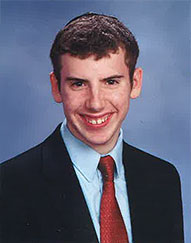
Yaffa & Ari Ash: Pursuing Yachad’s Mission Together
Yachad has changed many lives for the better in immeasurable ways. Two of those people are Yaffa and Ari Ash, who met each other through their work with Yachad. Yaffa was first exposed to Yachad via a Shabbaton she attended with a friend during high school. She soon found her niche, and from 2004 to 2009 she worked as a coordinator, advisor, and counselor in various Yachad programs, including Yad b’ Yad. Meanwhile, her future husband Ari, with whom she shared mutual childhood friends but had never actually met in person, also began to contribute his time and talents to Yachad. Eventually, Yaffa and Ari met at a Yachad Shabbaton in 2007 and became friends. Later that year, at the same site of the Shabbaton where they first met and worked together, Ari proposed. The importance of disability inclusion was instilled in Yaffa from a very early age by her mother, who worked in special education and exposed Yaffa to the diversity of humankind. Yaffa feels that this helped her achieve a greater understanding of how people with disabilities can and should fit as equal and useful members. She and Ari live by this belief in their daily lives, and they work tirelessly to impart the idea of true inclusion and equality to others. To further that goal, they advise teens to “forget all your expectations” about Yachad inclusion events “and think of it as just hanging out with new people.” This seemingly obvious piece of advice hides a powerful message. Many people in the wider world have unfortunate preconceived – and often downright incorrect – notions of what people with disabilities are like, and also about what it might be like to form social relationships with them. It’s important to remember that people with disabilities are simply people – people with hearts and minds and feelings. They can share so much with you, and you with them. “So get involved,” they encourage young people, “as we did.” And who knows? You might just meet that special someone who shares your values and commitment.
Deborah Berman is the Director of Social Work at Yachad
This is an article from Belong Magazine 2014. For more information, or to receive your own copy contact belong@ou.org
A highlight of the year for the entire New England Yachad community is the Tu B’Shevat Seder with K’sharim and Shaarei Tefillah Synagogue, which was held recently in Newton, MA. The Tu B’Shevat Seder ceremony commemorates the new year for trees, which falls on the 15th day of the Jewish month of Shevat. Individuals of all ages with disabilities, their families and the broader Jewish community participated. Congregation Shaarei Tefillah and its rabbi, Benjamin Samuels, have consistently shown eagerness to take initiatives to include people with disabilities into their community. Shaarei also co-sponsored the event and was recently recognized nationally by the Hineinu Initiative as one of the most “Inclusive synagogues in the country.”
Over 130 people attended the Tu B’shevat Seder. Over forty teen ‘peer participants’ also attended the Seder to enjoy the evening alongside their Yachad friends. At Yachad we don’t have “volunteers” because everything we do is inclusive – so our cadre or middle and high school students without disabilities, who attend activities alongside the individuals with disabilities, are called peer participants.
The Seder opened with two activities: working on a community mural with artist Tova Speter and completing a make-and-take arts and crafts project. The tables of the Shaarei Tefillah social hall were adorned with art supplies, make-your-own flower pots, stencils, and ceramic tiles waiting to be decorated. As the Seder participants began to create these bright, nature and/or tree-related projects, the atmosphere was one of friendship. Around the room, people helped each other out with their art, offering Tu B’Shevat inspired ideas for each other’s art projects and socializing. Eventually, the vast majority of people in the room had their own project to take home– either a decorative tile or a flower pot– and each was specific to each participant’s taste, yet united as part of one general theme of Tu B’Shevat and renewal.
Yachad tu bishvat
Perhaps most impressively, the girls of The Binah School in Sharon, MA led an array of activities. First, these motivated students publicized their recent projects in school that were part of a Binah School unit that focused on inclusion. Then, the Binah School invited the seder participants, table by table, outside into the synagogue’s atrium to contribute to their mural. The mural created by the Binah school and Tova Speter is traveling in pieces to disabilities groups and programs from across Greater Boston in addition to Yachad and K’sharim and is set to be the first public mural on display in the town of Sharon. The mural represents values of community and sharing. Every participant who wished to contribute had an opportunity to draw his or her own design in an individual portion of the mural. This activity was a great builder of self-esteem for all, especially the artistically talented Seder participants. (Unfortunately, I do not fit into this category!)
The Tu B’Shevat Seder continued with eating fruits and nuts of all kinds- from papaya to mango, kiwi to apricots, carob to cashews. The goal was to commemorate the new year for the trees and celebrate what they bring forth.
This year’s Tu B’Shevat seder was fun, inspirational, and unifying for our communities. We hope we can reach even higher heights in Seders to come!
Daniel Schwartz is a senior at The Maimonides School in Brookline. Among his many other hobbies and interests, which include baseball, acting, and Jewish learning, he has been involved for the past three years in New England Yachad. Daniel writes, “Our local Yachad club began as a small group of Maimo students who would go together to events within the Jewish community with a handful of people with disabilities. It remained small for many years. After a few of us attended Yachad’s National Leadership Shabbaton 2 years ago, we became committed to helping transform our Yachad chapter. Our commitment to doing more programs with individuals with disabilities received a huge boost with the support of Liz Offen, an inclusion expert, hired as the Director of New England Yachad. In a short time, our chapter grew to more than 250 participants– students and adults, people with and without disabilities, within the broader Jewish community.” Contact New England Yachad at NewEnglandYachad@ou.org
The Gabbai With Autism: A Living Lesson in Inclusion
By Bayla Sheva Brenner
Meet Eli Gorelik, the twenty-three-year-old gabbai whom Tifereth Israel’s 200-member congregation has come to respect and rely upon. He’s likely one of the youngest gabbaim in the world.
He’s also probably the only one with autism.
On Shabbat, Eli clears the bimah for Keriat haTorah; he also presents the yad to the ba’al keriah and assists with hagbahah and gelilah. Later in the day, at seudah shelishit, he hands out the bentchers. He prepares the candle and besamim for Havdalah andsometimes, on weekdays, serves as the gabbai who stands next to the ba’al korei. “The shul has become Eli’s home,” says his mother, Jacki.
“He has his routines,” says Yosef Avrahami, another gabbai (there are five in total) at the Passaic, New Jersey shul and a member there for close to four decades.
Eli developed normally for the first two years of his life; at fourteen months, he was walking and talking and freely interacting with those around him. Then things began to change.
“He wasn’t interested in other people,” Jacki says. “He was in his own world.” His preschool teacher reported that during circle time Eli would turn to face outside the circle. Eventually, he was diagnosed with autism.
Autism is the most common condition in a group of developmental disorders known as the autism spectrum disorders, and is characterized by varying degrees of impairment in sensory processing, speech and language development, social interaction and communication skills. The Centers for Disease Control and Prevention estimates that one out of 160 children in the country currently has autism.
Typical of children with autism, Eli demonstrated markedly rigid behavior. “If I didn’t have a bagel and cheese ready for him when he came home from preschool, he’d ‘lose it,’” says Jacki. “I couldn’t take him anywhere; he would fixate on the movement of the escalator or run back repeatedly to push the elevator buttons so he could watch the doors open and close.” The Goreliks’ other children noticed their brother was different. “It was tough [for them]; he was doing inappropriate things, like talking to himself, and he had problems communicating with others,” says Rabbi David Gorelik, Eli’s father, a rabbinic coordinator at the Orthodox Union (OU). “Once my older son asked why Hashem made Eli the way He did,” says Rabbi Gorelik. “I told him: ‘Hashem wanted us to do chesed for Eli.’”
The Goreliks enrolled Eli in a special program for children with developmental disabilities, where his responsiveness improved. “His world capacity is limited,” says Rabbi Gorelik. “Whereas you and I can talk about things outside of our experience, his interest lies solely in his own world.”
There’s No Place Like . . . Shul
When Eli was five, his father began taking him to Tifereth Israel, and shul quickly became the center of his world. “He loved it,” says Rabbi Gorelik. “He would sit through the rabbi’s sermon without making a sound.” Eli chose to occupy the chair on the pulpit, next to the rabbi. “Every time the rabbi finished his sermon, he’d run to shake his hand and say, ‘yasher koach!’” says Rabbi Gorelik. A shul member expressed his chagrin that “a child with autism [gives] the rabbi a yasher koach, when none of the others at the dais do,’” relates Rabbi Gorelik. “From then on, [everyone] began offering the rabbi yasher koach.”
As a young child, Eli would sit in his seat without participating in the service, his eyes following the rabbi’s every move. Over time, he became more involved. “Suddenly, I heard him saying Shema along with me,” says Rabbi Solomon Weinberger, who served as rabbi of the shul for more than four decades and is currently the rabbi emeritus. “And when I stood up for Shemoneh Esrei, he got up and stood next to me and bowed every time I bowed and shuckled [swayed] with me.”
Eli promptly picked up every word of the Shabbat davening. He even recited Kaddish Derabbanan with Rabbi Weinberger. “I had the only kid in town who was saying Kaddish for his parents while they were still alive,” jokes Eli’s mom. “It never fazed the rabbi; he has such love for every individual, and Eli grabbed onto it.”
“He seemed to gravitate to me and I enjoyed his friendship,” says Rabbi Weinberger. “The very fact that he was able to [come to] the pulpit and to stand next to the rabbi gave him a sense of importance, a feeling that he is wanted and cherished.”
When Eli turned eight, his parents informed him that it was time for him to sit with the rest of the congregation. Along with maturity came a sense of responsibility; he slowly began taking on the duties of a gabbai. One Shabbat around ten years ago, Avrahami says, when he approached the bimah, Eli started following him and participating in the preparation for the Torah reading. He’s been doing so ever since.
Eli’s mother attributes his high level of comfort with davening to Rabbi Weinberger’s magnanimity and the openness of congregants who followed the rabbi’s lead. Harry Fruhman, a former member of Tifereth Israel, made an immediate and meaningful connection with his young shul mate. It didn’t hurt that he was the congregation’s “candy man.” As Eli started coming to him for some goodies, Fruhman urged him to sit beside him; that ultimately became Eli’s official seat. “I would take his hand and use his finger to point to the places in the siddur to daven,” he says. Eli kept returning, and not always for the candy. “I’d offer him a lollipop,” says Fruhman. “He’d say ‘no’ and stick his finger out for me to show him where to daven. At Keriat haTorah, no matter where he was [in the sanctuary], he’d come running to me [so I could move] his finger to the place in the parashah.”
Over the years, Eli’s role in the shul has expanded—he is now also the official proofreader of the shul calendar. “He’s always been intrigued by calendars and has the eye to notice inconsistencies,” says his father. “On [last year’s] Rosh Hashanah schedule, he found a number of mistakes. He pointed out to me that Minchah should have been listed as 7:00 rather than 7:20. He also noticed that the hashkamah minyan wasn’t mentioned.” Now, each month, the shul sends Eli a draft of the calendar to proofread.
When Eli’s not in Passaic for Shabbat, he’s at a Yachad/National Jewish Council for Disabilities (NJCD)Shabbaton offering his inimitable help. Yachad/NJCD is the OU’s program dedicated to enhancing life for individuals with disabilities. “A lot of details, planning and strategizing go into a Yachad Shabbaton; it is possible to forget something,” says Naftali Herrmann, director of community outreach and engagement at Yachad. “The staff is comforted by the thought that if we forgot anything . . . Eli’ll be the first to realize it and let us know.”
“[At the Shabbatonim,] he was always the first one at Shacharit every morning,” says Herrmann. “If I came to shul late, he would point to his watch to let me know.”
Fruhman also notes the importance attending services holds for Eli. “One should never underestimate how meaningful davening is to children with special needs,” he says. “You might not think they are internalizing—unequivocally, they are.”
Rabbi Aaron Cohen, the current rabbi of Tifereth Israel, concurs. “When Eli gets an aliyah it gives him an [obvious] sense of pride,” he says. “His very strong connection to Torah and mitzvot makes an impact on the congregants.” And he makes sure Eli is cognizant of it. “It’s important that the rav has a personal relationship with children with special needs to demonstrate to them that they really matter and that they are an integral part of the shul,” he says. “When Eli is away for Shabbos, we’ll let him know we missed him.”
“[Eli] does the maximum to participate and has developed friendships with many congregants,” says Rabbi Cohen. “This sets the tone in the shul, showing that we care about each person.”
The community has also benefited from actively reaching out and embracing Eli. “He has taught us all humility, empathy, patience and [about having] a sense of humor,” says Jacki. “A child with special needs shows you what’s important, and what is not; he shows you how to extend yourself in order to understand and appreciate the value and blessing of every human being.”
When it comes to integrating individuals with special needs, Tifereth Israel’s congregation is a true model. “They’ve known Eli now for [more than] thirteen years,” says Jacki. “It’s rewarding to see how he’s developed and to watch him running out of the house and down the street to get to shul.”
Eli makes a point to leave home extra early, eager to take his rightful place in the congregation. For that, his family feels immeasurable hakarat hatov. “I thank my fellow congregants and both rabbis for having been so good to him; they’ve accepted him and treat him like anybody else. They look at him as another shul member.”
Yachad Joins Forces with Keshet Day Camp at Young Israel of East Brunswick
For this upcoming summer 2014, Yachad will be introducing a new program at Camp Keshet at the Young Israel of East Brunswick to bring a summer of fun for all in a day camp setting.
“Yachad,” the flagship program of the Orthodox Union’sNational Jewish Council for Disabilities (NCJD), provides unique social, educational and recreational programs for individuals with learning, developmental and physical disabilities with the goal of their Inclusion in the total life of the Jewish community. In addition to Camp Keshet, Yachad runs inclusive summer programs for individuals of all ages across the United States and in Israel.
“First and foremost we want the kids to have fun,” said Dr. Joe Goldfarb, Director of Yachad Summer Programs. “We want parents to be able to send ALL their children with and without disabilities to the same local day camp, and we feel the goal is for the children to learn social skills with the ultimate goal of Inclusion. This is the first year that we have started a Yachad program in the Middlesex region and we are very excited about it.”
“At Camp Keshet,” Dr. Goldfarb said, “children will enjoy a fantastic summer filled with great friends, encouraging and supportive staff, and exciting challenges, all within camp days filled with lessons on Jewish values, Hebrew words and love of Israel.”
The program, which runs from first through eighth grade, will have Yachad campers accompanied by trained staff shadows learning social skills and joining mainstream campers in daily activities. These include twice-daily swim, sports, electives, chinuch (learning), education about Israel, trips, and much more. Hot lunches will be provided. Busing options will be available in surrounding areas.
“We always individualize the program to allow for as much Inclusion as possible,” explained Dr. Goldfarb.
Says Melissa Rosen, Director of Camp Keshet, “We are excited by this new partnership with Yachad. Given the Young Israel of East Brunswick’s already strong partnership with Yachad, to include our summer camp was a natural fit. The opportunity to meet the needs of special campers, to provide them with a challenging and exciting Jewish summer experience, benefits our entire Camp Keshet community. We are proud to welcome Yachad into that community and look forward to a summer filled with smiles!”

 Yachad has changed many lives for the better in immeasurable ways. Two of those people are Yaffa and Ari Ash, who met each other through their work with Yachad. Yaffa was first exposed to Yachad via a Shabbaton she attended with a friend during high school. She soon found her niche, and from 2004 to 2009 she worked as a coordinator, advisor, and counselor in various Yachad programs, including Yad b’ Yad. Meanwhile, her future husband Ari, with whom she shared mutual childhood friends but had never actually met in person, also began to contribute his time and talents to Yachad. Eventually, Yaffa and Ari met at a Yachad Shabbaton in 2007 and became friends. Later that year, at the same site of the Shabbaton where they first met and worked together, Ari proposed. The importance of disability inclusion was instilled in Yaffa from a very early age by her mother, who worked in special education and exposed Yaffa to the diversity of humankind. Yaffa feels that this helped her achieve a greater understanding of how people with disabilities can and should fit as equal and useful members. She and Ari live by this belief in their daily lives, and they work tirelessly to impart the idea of true inclusion and equality to others.
 ![ashedited-9970[1]](https://yachad-assets.oudev.org/wp-content/uploads/2014/06/10084144/ashedited-99701.jpeg) To further that goal, they advise teens to “forget all your expectations” about Yachad inclusion events “and think of it as just hanging out with new people.” This seemingly obvious piece of advice hides a powerful message. Many people in the wider world have unfortunate preconceived – and often downright incorrect – notions of what people with disabilities are like, and also about what it might be like to form social relationships with them. It’s important to remember that people with disabilities are simply people – people with hearts and minds and feelings. They can share so much with you, and you with them. “So get involved,” they encourage young people, “as we did.” And who knows? You might just meet that special someone who shares your values and commitment.
To further that goal, they advise teens to “forget all your expectations” about Yachad inclusion events “and think of it as just hanging out with new people.” This seemingly obvious piece of advice hides a powerful message. Many people in the wider world have unfortunate preconceived – and often downright incorrect – notions of what people with disabilities are like, and also about what it might be like to form social relationships with them. It’s important to remember that people with disabilities are simply people – people with hearts and minds and feelings. They can share so much with you, and you with them. “So get involved,” they encourage young people, “as we did.” And who knows? You might just meet that special someone who shares your values and commitment.