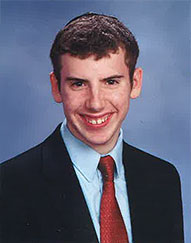
Sam Paster of Swampscott with fellow KinderCamp counselors. Sam is working as a counselor, leading art and science activities at KinderCamp.
Besides having fun at “Summer on the Hill” held at the Jewish Community Center of the North Shore in Marblehead, campers and counselors alike are learning important lessons about inclusion.
Swampscott resident Melissa Caplan is directing a pilot of the new inclusion camp there which has attracted 21 campers and five staff members with physical, cognitive and/or social disabilities. In addition, the program provides supports for 10 other children with special needs who entered through general camp registration.
“We are taking a camp that already exists and making modifications so they can participate in activities along with their chronologically-aged peers,” Caplan said. These modifications range from using a bright orange ball for games to accommodate campers with visual impairments, to providing an aide, or even two, trained in special education. These services are given free of charge with camp enrollment.
JCCNS Youth and J-Adventure Director and Assistant Camp Director Ashley Corcoran said of the inclusion program, “It’s not a separate camp. We have embedded these kids in all of our programs.”
For example, Evan Goodman, 12, of Salem, who has high-functioning autism, needs extra help with getting his belongings together; making transitions between activities; focusing on tasks; and coping with frustration, according to his mother, Mary Goodman. She said Evan had difficultly attending a local summer camp one year.
“He couldn’t follow group instructions. I am not sure he stayed on track. He felt lonely; I think he spent a lot of time by himself,” Mary Goodman said.
On the contrary, Evan has flourished at the JCCNS Camp Simchah, which offers entering first- through seventh-graders nine one-week specialty camps like cooking, art, soccer and baseball; and an option for a traditional camp experience. With a young man helping him, Evan has participated successfully in the engineering session, and will be taking cartooning later on in the summer. His mother said he has made friends at camp.
“We don’t want him to stay at home with a babysitter. We want him to be out swimming, doing activities, and being with other kids. It would not have been possible without this,” Goodman said.
Caplan, a longtime special education teacher, works alongside Corcoran, KinderCamp (for preschoolers through children entering Kindergarten) Director Heather Greenberg and Camp Director Josh Ackman to ensure all of the supports are in place. Caplan remains flexible, for instance, allowing campers with special needs to arrive in the early afternoon after attending their school-sponsored summer programs.
But it’s not only those enrolled in the inclusion camp who are benefiting from the program.
Camper Stella Puzzo of Swampscott with her friends at a Dance enrichment program at KinderCamp.
Caplan said [typical] campers have been accepting. For example, kids in the drama group encouraged a boy with autism [which is often associated with difficulty socializing] to create his own character and perform it in a play. Youngsters in the Kindercamp Dance Enrichment Program practice alongside Stella Puzzo, 5, of Swampscott, a participant who uses a wheelchair.
Ava Grable, 8, of Swampscott has befriended a couple of children with special needs. “They are very sweet kids. If I was a kid [with disabilities], they would be nice to me,” Grable said.
Corcoran said camp staff were “setting a tone” for kids to learn acceptance. Caplan said staff members teach this through modeling appropriate behavior so everyone feels welcome and respected.
Caplan spoke to “Summer on the Hill” JTI (Jewish Teen Internship) tenth- and eleventh-grade counselors-in-training about demonstrating empathy towards individuals with special needs. One girl was so moved that she recommended holding a party purposely including peers with disabilities.
Inclusion has come full-circle this summer for KinderCamp counselor Sam Paster, 17, of Swampscott. A student at the Cotting School in Lexington, Paster has cerebral palsy and uses a wheelchair. Working once a week, he takes attendance of the children of his group, distributes art supplies and guides campers through projects, in addition to other responsibilities.
“He’s thrilled about it. He likes being a leader and a role model for the kids,” Paster’s mother, Hilory Paster said.
Hilory Paster said that like teenagers his age, Sam wants to follow his passion, set goals, learn job skills, and earn some pocket money. She said he had an “amazing experience” this past year volunteering by distributing meals and helping people with disabilities. However, earning his own money has meant a lot to him.
“Payment gives validation to your work. Sam is recognized as an employee,” Hilory Paster said. She said the “behind the scenes” support provided by JCCNS enables Sam to participate. He hopes to take on more days next month.
Hilory Paster noted that often when a kid has a disability, “they are one people volunteer to help.” She said that through the inclusion efforts of JCCNS, “Sam has become a giver… It shows that people with disabilities can be givers, while also being receivers.”
Those interested in more information about the Inclusion Camp at JCCNS and other JCCNS inclusion programs should contact Youth Director Ashley Corcoran at 781-476-9907; acorcoran@jccns.com.
This article was written by Nicole Levy, a staff writer from Wicked Local: Swampscott. View the original article here.
Bringing Yachad Programming Back to School
(L-R) Michal Grossman, Avital Listman
We signed up for Yad B’ Yad, Yachad’s Israel travel program for teens with and without disabilities, not knowing what to expect. It turned out to be a life-changing experience that inspired us to get further involved in Yachad. We had made long-lasting friendships and learned the importance of inclusion and of incorporating that mentality into our lives daily. As soon as we got back to school after the summer, we were eager to share our new passion and commitment to this cause with the rest of our school community. Yachad Youth Leadership Council (YYLC), Yachad’s board of active high school leaders from the New York Metropolitan area, gave us the tools to bring Yachad programming back to our school.
We are grateful to our principal, Mrs. Neugroschl at Yeshiva University High School for Girls, for embracing our initiative. She allowed us to establish a Yachad Club at our school. We began the club by introducing participants to Yachad’s mission of inclusion, stressing its famous tagline “Because Everyone Belongs.” Our thirty club members took on organizing a school-wide sensitivity training – a simulation of what it may be like to have a disability, with guidance from Rebecca Schrag, Yachad’s director of School and Community Programming (and Yad B’Yad), and Laura Fruchter, director of Yachad’s program at Camp Morasha. Students left the sensitivity training with a greater appreciation of the tools they have, a greater degree of patience and empathy for their peers, a sense of commitment towards being more welcoming to their peers with disabilities and a thirst for more Yachad programming.
Soon after, we were honored to host the Marilyn David IVDU Upper School – Girls Division (Yachad’s school for young women with disabilities) for a pre-Purim chagigah (party). We loved seeing girls of all abilities come together to usher in the Purim spirit. And we received great feedback from IVDU Upper School as well as from our friends and faculty at school.
Proud to be a part of real change within our school, we feel so empowered every time a peer asks us about using sensitive “person first” language, how to get Yachad apparel, or how to get involved in upcoming events and Shabbatonim. We love the leadership role Yachad empowers us to take, and the position it gives us in our school community. We look forward to our school’s continued involvement with Yachad’s important work and seeing where the Yachad Club will go next.
Yachad has changed our personal lives so much that we did something we never thought was possible: we joined Team Yachad 2014. Running 13.1 miles in Miami with Team Yachad, in support of inclusion, was quite an achievement. It was really hard, but what got us through it was the thought that we were doing it for a cause that means so much to us.
As we began to think about our plans for the upcoming summer, we couldn’t give up the opportunity to spend it with Yachad. This summer, we will both participate in Yachad’s Morris Sandelbaum High School Fellowship Program. This fellowship places students going into 12th grade as staff members in one of Yachad’s summer programs. We were both lucky enough to be given the opportunity to work in Camp Morasha, our first choice.
About YYLC
Yachad Youth Leadership Council helps shape the future of Yachad and implements programs of change within Yachad, schools and communities. Council members participate in leadership development opportunities and serve as inclusion liaisons for their various communities. Looking for relevant and creative ways to educate their communities and share their passions, members help construct and publicize local Yachad events, Shabbatonim and fundraisers. They bring sensitivity trainings, awareness campaigns and speakers on topics relating to disabilities to their local schools and synagogues. Once exposed to their enthusiasm, it’s hard not to join their stimulating projects!
This year YYLC is focusing on purposeful social media. For NAIM (North American Inclusion Month), members created images with inclusion tips for every day of the month – for students, by students – under the tagline #28daysofinclusion. YYLC is currently launching a video competition where individuals can submit video shorts on topics surrounding disabilities.
For more information on YYLC contact Rebecca Schrag at SchragR@ou.org or 212-613-8223.
Michal Grossman and Avital Listman are Juniors at Samuel H. Wang Yeshiva University High School for Girls.
This is an article from Belong Magazine 2014. For more information, or to receive your own copy contact belong@ou.org
A highlight of the year for the entire New England Yachad community is the Tu B’Shevat Seder with K’sharim and Shaarei Tefillah Synagogue, which was held recently in Newton, MA. The Tu B’Shevat Seder ceremony commemorates the new year for trees, which falls on the 15th day of the Jewish month of Shevat. Individuals of all ages with disabilities, their families and the broader Jewish community participated. Congregation Shaarei Tefillah and its rabbi, Benjamin Samuels, have consistently shown eagerness to take initiatives to include people with disabilities into their community. Shaarei also co-sponsored the event and was recently recognized nationally by the Hineinu Initiative as one of the most “Inclusive synagogues in the country.”
Over 130 people attended the Tu B’shevat Seder. Over forty teen ‘peer participants’ also attended the Seder to enjoy the evening alongside their Yachad friends. At Yachad we don’t have “volunteers” because everything we do is inclusive – so our cadre or middle and high school students without disabilities, who attend activities alongside the individuals with disabilities, are called peer participants.
The Seder opened with two activities: working on a community mural with artist Tova Speter and completing a make-and-take arts and crafts project. The tables of the Shaarei Tefillah social hall were adorned with art supplies, make-your-own flower pots, stencils, and ceramic tiles waiting to be decorated. As the Seder participants began to create these bright, nature and/or tree-related projects, the atmosphere was one of friendship. Around the room, people helped each other out with their art, offering Tu B’Shevat inspired ideas for each other’s art projects and socializing. Eventually, the vast majority of people in the room had their own project to take home– either a decorative tile or a flower pot– and each was specific to each participant’s taste, yet united as part of one general theme of Tu B’Shevat and renewal.
Yachad tu bishvat
Perhaps most impressively, the girls of The Binah School in Sharon, MA led an array of activities. First, these motivated students publicized their recent projects in school that were part of a Binah School unit that focused on inclusion. Then, the Binah School invited the seder participants, table by table, outside into the synagogue’s atrium to contribute to their mural. The mural created by the Binah school and Tova Speter is traveling in pieces to disabilities groups and programs from across Greater Boston in addition to Yachad and K’sharim and is set to be the first public mural on display in the town of Sharon. The mural represents values of community and sharing. Every participant who wished to contribute had an opportunity to draw his or her own design in an individual portion of the mural. This activity was a great builder of self-esteem for all, especially the artistically talented Seder participants. (Unfortunately, I do not fit into this category!)
The Tu B’Shevat Seder continued with eating fruits and nuts of all kinds- from papaya to mango, kiwi to apricots, carob to cashews. The goal was to commemorate the new year for the trees and celebrate what they bring forth.
This year’s Tu B’Shevat seder was fun, inspirational, and unifying for our communities. We hope we can reach even higher heights in Seders to come!
Daniel Schwartz is a senior at The Maimonides School in Brookline. Among his many other hobbies and interests, which include baseball, acting, and Jewish learning, he has been involved for the past three years in New England Yachad. Daniel writes, “Our local Yachad club began as a small group of Maimo students who would go together to events within the Jewish community with a handful of people with disabilities. It remained small for many years. After a few of us attended Yachad’s National Leadership Shabbaton 2 years ago, we became committed to helping transform our Yachad chapter. Our commitment to doing more programs with individuals with disabilities received a huge boost with the support of Liz Offen, an inclusion expert, hired as the Director of New England Yachad. In a short time, our chapter grew to more than 250 participants– students and adults, people with and without disabilities, within the broader Jewish community.” Contact New England Yachad at NewEnglandYachad@ou.org
The Gabbai With Autism: A Living Lesson in Inclusion
By Bayla Sheva Brenner
Meet Eli Gorelik, the twenty-three-year-old gabbai whom Tifereth Israel’s 200-member congregation has come to respect and rely upon. He’s likely one of the youngest gabbaim in the world.
He’s also probably the only one with autism.
On Shabbat, Eli clears the bimah for Keriat haTorah; he also presents the yad to the ba’al keriah and assists with hagbahah and gelilah. Later in the day, at seudah shelishit, he hands out the bentchers. He prepares the candle and besamim for Havdalah andsometimes, on weekdays, serves as the gabbai who stands next to the ba’al korei. “The shul has become Eli’s home,” says his mother, Jacki.
“He has his routines,” says Yosef Avrahami, another gabbai (there are five in total) at the Passaic, New Jersey shul and a member there for close to four decades.
Eli developed normally for the first two years of his life; at fourteen months, he was walking and talking and freely interacting with those around him. Then things began to change.
“He wasn’t interested in other people,” Jacki says. “He was in his own world.” His preschool teacher reported that during circle time Eli would turn to face outside the circle. Eventually, he was diagnosed with autism.
Autism is the most common condition in a group of developmental disorders known as the autism spectrum disorders, and is characterized by varying degrees of impairment in sensory processing, speech and language development, social interaction and communication skills. The Centers for Disease Control and Prevention estimates that one out of 160 children in the country currently has autism.
Typical of children with autism, Eli demonstrated markedly rigid behavior. “If I didn’t have a bagel and cheese ready for him when he came home from preschool, he’d ‘lose it,’” says Jacki. “I couldn’t take him anywhere; he would fixate on the movement of the escalator or run back repeatedly to push the elevator buttons so he could watch the doors open and close.” The Goreliks’ other children noticed their brother was different. “It was tough [for them]; he was doing inappropriate things, like talking to himself, and he had problems communicating with others,” says Rabbi David Gorelik, Eli’s father, a rabbinic coordinator at the Orthodox Union (OU). “Once my older son asked why Hashem made Eli the way He did,” says Rabbi Gorelik. “I told him: ‘Hashem wanted us to do chesed for Eli.’”
The Goreliks enrolled Eli in a special program for children with developmental disabilities, where his responsiveness improved. “His world capacity is limited,” says Rabbi Gorelik. “Whereas you and I can talk about things outside of our experience, his interest lies solely in his own world.”
There’s No Place Like . . . Shul
When Eli was five, his father began taking him to Tifereth Israel, and shul quickly became the center of his world. “He loved it,” says Rabbi Gorelik. “He would sit through the rabbi’s sermon without making a sound.” Eli chose to occupy the chair on the pulpit, next to the rabbi. “Every time the rabbi finished his sermon, he’d run to shake his hand and say, ‘yasher koach!’” says Rabbi Gorelik. A shul member expressed his chagrin that “a child with autism [gives] the rabbi a yasher koach, when none of the others at the dais do,’” relates Rabbi Gorelik. “From then on, [everyone] began offering the rabbi yasher koach.”
As a young child, Eli would sit in his seat without participating in the service, his eyes following the rabbi’s every move. Over time, he became more involved. “Suddenly, I heard him saying Shema along with me,” says Rabbi Solomon Weinberger, who served as rabbi of the shul for more than four decades and is currently the rabbi emeritus. “And when I stood up for Shemoneh Esrei, he got up and stood next to me and bowed every time I bowed and shuckled [swayed] with me.”
Eli promptly picked up every word of the Shabbat davening. He even recited Kaddish Derabbanan with Rabbi Weinberger. “I had the only kid in town who was saying Kaddish for his parents while they were still alive,” jokes Eli’s mom. “It never fazed the rabbi; he has such love for every individual, and Eli grabbed onto it.”
“He seemed to gravitate to me and I enjoyed his friendship,” says Rabbi Weinberger. “The very fact that he was able to [come to] the pulpit and to stand next to the rabbi gave him a sense of importance, a feeling that he is wanted and cherished.”
When Eli turned eight, his parents informed him that it was time for him to sit with the rest of the congregation. Along with maturity came a sense of responsibility; he slowly began taking on the duties of a gabbai. One Shabbat around ten years ago, Avrahami says, when he approached the bimah, Eli started following him and participating in the preparation for the Torah reading. He’s been doing so ever since.
Eli’s mother attributes his high level of comfort with davening to Rabbi Weinberger’s magnanimity and the openness of congregants who followed the rabbi’s lead. Harry Fruhman, a former member of Tifereth Israel, made an immediate and meaningful connection with his young shul mate. It didn’t hurt that he was the congregation’s “candy man.” As Eli started coming to him for some goodies, Fruhman urged him to sit beside him; that ultimately became Eli’s official seat. “I would take his hand and use his finger to point to the places in the siddur to daven,” he says. Eli kept returning, and not always for the candy. “I’d offer him a lollipop,” says Fruhman. “He’d say ‘no’ and stick his finger out for me to show him where to daven. At Keriat haTorah, no matter where he was [in the sanctuary], he’d come running to me [so I could move] his finger to the place in the parashah.”
Over the years, Eli’s role in the shul has expanded—he is now also the official proofreader of the shul calendar. “He’s always been intrigued by calendars and has the eye to notice inconsistencies,” says his father. “On [last year’s] Rosh Hashanah schedule, he found a number of mistakes. He pointed out to me that Minchah should have been listed as 7:00 rather than 7:20. He also noticed that the hashkamah minyan wasn’t mentioned.” Now, each month, the shul sends Eli a draft of the calendar to proofread.
When Eli’s not in Passaic for Shabbat, he’s at a Yachad/National Jewish Council for Disabilities (NJCD)Shabbaton offering his inimitable help. Yachad/NJCD is the OU’s program dedicated to enhancing life for individuals with disabilities. “A lot of details, planning and strategizing go into a Yachad Shabbaton; it is possible to forget something,” says Naftali Herrmann, director of community outreach and engagement at Yachad. “The staff is comforted by the thought that if we forgot anything . . . Eli’ll be the first to realize it and let us know.”
“[At the Shabbatonim,] he was always the first one at Shacharit every morning,” says Herrmann. “If I came to shul late, he would point to his watch to let me know.”
Fruhman also notes the importance attending services holds for Eli. “One should never underestimate how meaningful davening is to children with special needs,” he says. “You might not think they are internalizing—unequivocally, they are.”
Rabbi Aaron Cohen, the current rabbi of Tifereth Israel, concurs. “When Eli gets an aliyah it gives him an [obvious] sense of pride,” he says. “His very strong connection to Torah and mitzvot makes an impact on the congregants.” And he makes sure Eli is cognizant of it. “It’s important that the rav has a personal relationship with children with special needs to demonstrate to them that they really matter and that they are an integral part of the shul,” he says. “When Eli is away for Shabbos, we’ll let him know we missed him.”
“[Eli] does the maximum to participate and has developed friendships with many congregants,” says Rabbi Cohen. “This sets the tone in the shul, showing that we care about each person.”
The community has also benefited from actively reaching out and embracing Eli. “He has taught us all humility, empathy, patience and [about having] a sense of humor,” says Jacki. “A child with special needs shows you what’s important, and what is not; he shows you how to extend yourself in order to understand and appreciate the value and blessing of every human being.”
When it comes to integrating individuals with special needs, Tifereth Israel’s congregation is a true model. “They’ve known Eli now for [more than] thirteen years,” says Jacki. “It’s rewarding to see how he’s developed and to watch him running out of the house and down the street to get to shul.”
Eli makes a point to leave home extra early, eager to take his rightful place in the congregation. For that, his family feels immeasurable hakarat hatov. “I thank my fellow congregants and both rabbis for having been so good to him; they’ve accepted him and treat him like anybody else. They look at him as another shul member.”
Camp Moshava Malibu
This summer, Yachad will introduce a new program at Camp Moshava Malibu at the Shalom Institute Campgrounds in Malibu, CA, to bring a summer of fun and Inclusion for all in a summer camp setting.
Campers will be between the ages of 8-16. Each Yachad camper will be accompanied by a shadow throughout the camp season. The shadows and program director of the Yachad program in Moshava Malibu will be hired and trained by Yachad and will serve as full members of the Moshava team. The Yachad program at Moshava Malibu will provide supervision for each child on his or her own unique level.
“Yachad,” the flagship program of the Orthodox Union’s National Jewish Council for Disabilities (NCJD), provides unique social, educational and recreational programs for individuals with learning, developmental and physical disabilities with the goal of their Inclusion in the total life of the Jewish community.
Camp Moshava Malibu, entering its second year, operates under the umbrella of Bnei Akiva, the religious Zionist youth movement of inspiring and empowering the Jewish youth of North America with a deep commitment to Am Yisrael, Eretz Yisrael, and Torat Yisrael. The camp’s duration will expand this year to eighteen days from two weeks last year. Moshava Malibu is the fourth Bnei Akiva-affiliated camp to join forces with Yachad, along with Camp Moshava Indian Orchard (IO) in Pennsylvania; Moshava Ba’ir in New Jersey; and Moshava Ba’ir in Toronto.
“This new program continues our strong relationship with Bnei Akiva,” Dr. Joe Goldfarb, director of summer programs at Yachad, said. “From the time that Moshava Malibu began preparations for the camp, Rabbi Kenneth Pollack, the camp director, has been in touch with us, because they could not imagine having a camp without including children with special needs. Their first year was a tremendous success and we are looking forward to campers with special needs enjoying the fun and exciting Israel-centered programs that are being offered.”
Rabbi Pollack shared: “I am very excited about this new partnership. Bringing Yachad into our Moshava setting is the perfect blend of professionalism and maintaining the Moshava brand, which is very important. Working with people who know how our model works is very important to me. Additionally, the Inclusion model that we are going to be working with will not only benefit our special needs campers, but will add to the overall environment that we hope to create in camp.”
According to Orit Faguet, director of Yachad Los Angeles, “Yachad promotes an atmosphere of inclusion, simultaneously helping to integrate those with special needs in our community and improving the sensitivity of those without special needs who participate in our programs. We hope to bring that same spirit of inclusion and sensitivity to Moshava Malibu and provide a great camp experience for our members with special needs here in the Los Angeles area.”
The campus includes an Olympic-sized swimming pool, high-and-low-element rope courses, an organic farm, an Israel discovery center and garden, sports and archery fields, a climbing wall, animal education center, dining hall and health center, outdoor amphitheaters, campfire areas and outdoor fireplace, arts and crafts pavilion, hiking trails directly to the beach, and waterfalls. Daily shiurim (learning sessions) will be filled with interactive activities that educate campers about Hakamat Hamedina (the establishment of the State of Israel) – the camp’s planned theme for this summer.
For further information please contact Nechama Braun at yachadsummer@ou.org or 212.613.8368 or visit yachad.org/summerprograms. For questions and registration, please email office@moshavamalibu.org, or call its toll free number 855-MOSHAVA. Office hours are 9 a.m. – 2 p.m. PST. The year-round office is located at Bnei Akiva of Los Angeles, 9030 West Olympic Blvd, Beverly Hills, CA 90211.
Why is Inclusion Important for the Entire Community?”
In honor of North American Inclusion Month, Yachad/The National Council for Jewish Disabilities has put together a series of mini webinars on inclusion. Videos will be released monthly. This month Dr. Jeff Lichtman, International Director of Yachad, is presenting “Why is Inclusion Important for the Entire Community?”
New England Yachad awarded $50,000 Ruderman Family Foundation Grant to Expand Inclusive Programming Outside Greater Boston Area
December 9, 2013 By Batya Rosner
It’s Yachad’s mission to improve the life of those living with a disability in the Jewish community and to create opportunities for everyone to participate in Jewish life, according to their ability. But not everyone who would benefit from Yachad’s mission of inclusion lives right in the heart of the Jewish community. Sometimes, Yachad needs to look a little further afield.
Yachad, the National Jewish Council for Disabilities (NJCD), is the flagship agency of the Orthodox Union which provides unique social, educational and recreational programs for individuals with learning, developmental and physical disabilities. Its goal is to promote their inclusion in the life of the Jewish community.
Dedicated to turning these ideals into reality, the Ruderman Family Foundation has partnered with New England Yachad by awarding a $50,000 grant to expand inclusive programming outside the Greater Boston Metropolitan area.
The Ruderman Family Foundation, based in the United States and Israel, supports effective programs, innovative partnerships and a dynamic approach to philanthropy advocating for and advancing the inclusion of people with disabilities throughout the Jewish community.
“The mission statements of Yachad and the Ruderman Family Foundation are so intertwined, it’s a blessing that we are able to partner together to continue promoting inclusion throughout the New England region,” said Dr. Jeffrey Lichtman, international director of Yachad/NJCD. “There are hundreds of families who would be able to benefit from Yachad’s services and inclusive programming; and now, together with the Ruderman Family Foundation, we will better be able to reach and assist those individuals.”
New England Yachad was approached this Fall as a potential applicant to receive a grant by the Foundation.
“Young people with disabilities are often socially challenged and isolated,” described Liz Offen, director of New England Yachad. “When our Yachad participants were willing to drive close to an hour each way to attend a Boston program, we realized that we could have an even greater impact on their lives if we could bring our programming to them.”
She continued, “This project targets dozens of individuals and families bringing inclusive social/recreational activities to communities currently lacking these vital programs, minimizing isolation while promoting and fostering friendships.”
A Plan of Action
Each geographic area identified for the Ruderman Family Foundation grant has a unique plan of action based upon the needs of the community in order to establish sustainable services and inclusive programs where they do not currently exist. The grant will fund part-time positions for the North Shore and South Area; and a social worker at Jewish Family Services of Metrowest. These positions will allow New England Yachad to offer similar opportunities and in some cases more than what currently exists in the Greater Boston programs, Offen noted.
“I have been impressed with Yachad’s national model,” stated Sharon Shapiro, Ruderman Family Foundation trustee. “Yachad’s work embodies the core belief of our foundation that ‘including each is strengthening all.’ Liz Offen is an inclusion specialist. Many people in the community feel comfortable with her because she understands the needs of individuals of all ages with disabilities. Yachad works with children, teens and adults with and without disabilities, understanding the importance of inclusion to help create a fair and flourishing Jewish community.”
Programming for the new geographic expansions funded by the Ruderman Family Foundation have already hit the ground running with great potential: In the North Shore, New England Yachad has reached out to the local Jewish Community Center and synagogues, working to coordinate a welcoming event. An active chapter has developed at The Binah School in Sharon, where mainstream students participate in a yearlong sensitivity training and awareness for disabilities and inclusion (including a visit to the Perkins School for the Blind). They hold monthly programs at school for children in the South Area to do crafts, games, and socialize; a Chanukah party took place during the holiday.
Upcoming activities in the South Area include team building and rockwall climbing at The RockSpot in Boston on Monday, December 23 and pottery painting at Ceramics-a-la-Carte on Sunday, December 29. Additionally, three Shabbatons and a bowl-a-thon are to be scheduled. “Our annual Tu B’Shevat seder with Congregation Shaarei Tefillah in Newton on Sunday, January 19, is one of the highlights of the year,” Offen also shared. “Last year, 125 people attended.”
New England Yachad is fostering partnerships to secure partners across Massachusetts with local synagogues, social service agencies, schools and the broad Jewish community to expand awareness, increase programming, and support families of individuals with disabilities.
For further information and to get involved with New England Yachad, contact Liz Offen at NewEnglandYachad@ou.org or 646.628.7003.
The Orthodox Union, known by the OU symbol, is the world’s largest kosher certification organization. Founded in 1898, the OU certifies nearly two million products and ingredients in 8,000 plants in more than 83 countries. The OU impacts the larger Jewish world through its youth and educational programs like NCSY, NCSY Alumni, JLIC (Jewish Learning Initiative on Campus), Israel Free Spirit-Birthright and others, Yachad and its disability support networks, the OU Job Board, the OU Advocacy political action arm, Synagogue and Community Services, OU Israel, the OU Press publishing division, OU.org and OUTorah.org, and Jewish Action magazine. Each and every day, countless Jewish individuals and families around the world are positively impacted by the work of the Orthodox Union.
Contact: Stephen Steiner Director of Public Relations 212.613.8318; steiners@ou.org
Yachad Announces Hineinu, a Partnership Across the Jewish Spectrum to Promote Inclusion
November 11, 2013
By Stephen Steiner
Yachad, an agency of the Orthodox Union has embarked on Hineinu: Jewish Community for People of All Abilities, the latest initiative in its goal of bringing full Inclusion in Jewish life to those with disabilities. Hineinu (“We are here”)is the first-ever formal combination of human rights and disability professionals from each of the four religious streams, sharing resources, support and direction in order to increase disability Inclusion in our synagogues for people of all abilities.
In order to actively and systematically increase disability Inclusion at the synagogue level, the Orthodox Union is partnering with the Conservative, Reform, and Reconstructionist movements. “There will be no sharing of religious services or practices between the OU and other denominations – that is not the goal of Hineinu,” said Dr. Jeffrey Lichtman, international director of the National Jewish Council for Disabilities (NJCD), which includes Yachad as its flagship program.
Yachad, the only international disability agency serving the Jewish community, provides a full gamut of unique programs and services for individuals with learning, developmental, and physical disabilities.
Hineinu is based on the principle that if each synagogue community fosters attitudes of Inclusion and acceptance in a direct and meaningful way, this change will grow and develop into a wholly inclusive larger Jewish world.
Hineinu is the outgrowth of the efforts of Deborah Berman, LCSW, director of social work for Yachad. She, along with colleague Rabbi Lynne Landsberg, senior advisor on disability issues for the Religious Action Center of Reform Judaism, conceived the idea of bringing the four streams together on behalf of widespread synagogue-based Inclusion. With Dr. Lichtman’s support, this groundbreaking initiativewas set in motion and the Reconstructionist and Conservative movements were invited to join as well.
“Hineinu is an historic collaboration, a joint effort which, in itself, exemplifies the spirit of Inclusion that we hope to bring to synagogues and to people with natural variations in abilities and disabilities,” Deborah Berman explained. “On the grassroots, community level, we will promote the Inclusion of each and every Jew, regardless of natural variations in abilities and disabilities, to take their rightful place in the Jewish world.”
“The Jewish people have long been in the vanguard of moving the human race forward. Indeed, we each carry within us a spark of the Divine,” Dr. Lichtman said. “We must now ignite that spark as we work B’Yachad (together) to actively welcome, respect, and appreciate that divine spark within our fellow community members and/or children who have disabilities.”
Dr. Lichtman emphasized, “Yachad takes great pride in what we have achieved to date; in the awareness that we have fostered; and the Inclusion that we have created. Yet there remains much still to do and Yachad and the OU welcome our Hineinu partners who join with us to include everyone, to value everyone, to welcome everyone, because everyone belongs!”
Guided and energized by its collaboration through Hineinu, Dr. Lichtman declared, each stream of Judaism will work with a pilot group of synagogues within their own movements, to support them in setting and achieving measurable goals of increasing community Inclusion through appropriately tailored steps and initiatives.
To date, approximately 40 synagogues are signing on to participate with Hineinu in its first year.
Many of these synagogues will be creating or expanding Inclusion committees at participating synagogues. These committees will be charged with implementing disability Inclusion practices in their own communities. By February, 2014, also known as North American Inclusion Month (NAIM), Hineinu’sInclusion Committees will hold disability-focused events or Shabbat activities; release their agendas for the year; and their plans for bringing persons with disabilities into their synagogue communities.
To facilitate these efforts, Hineinu has developed an online disability resources guide for rabbis, which Yachad has tailored to meet the needs of Orthodox clergy. The guide contains ideas and suggestions for making synagogue and communal life more disability-friendly. To access this guide, go to OU’s Community Services web page, http://www.ou.org/synagogue_services/#
For further information, or to become a participating synagogue in the Hineinu initiative with the Orthodox Union, contact:
Deborah Berman, LCSW, Director of Social Work: bermand@ou.org; 212-613-8172
or Dr. Jeff Lichtman, International National Director: Lichtmanj@ou.org: 212-613-8229
Contact: Stephen Steiner Director of Public Relations 212.613.8318; steiners@ou.org