To me, Inclusion means being welcomed into the group. At Yachad I feel that I am always included and not left alone during meals, at events, or at Shabbatonim. Friends and staff make an effort to talk to me and reach out if I have questions. No one judges me based on my disability or teases me. Everyone is accepting of me just as I am.
Inclusion is an important part of Yachad, and everyone believes in making an effort to reach out to others and to make sure each individual is given the attention that they need. I believe that every person is unique and special in his or her own way.
Sometimes I get nervous when I speak, and hesitate, but my friends are patient with me because what I have to say is important to them. I have learned how to start conversations with people — I used to be quiet but now I feel comfortable going up to people and introducing myself at Yachad events.
Expanding my Jewish Identity
Jonathan and Emma Gelb on Tu B’svhat
I am always eager to learn more about my Jewish identity, holidays, and customs. At Yachad, friends of mine have helped me daven (pray), and practice reading Hebrew. By the end of the Yad B’Yad summer travel program in 2014, I could read a couple of pages of Hebrew without hesitating. I gained more confidence in myself. I choose to daven with my friends because they help me to follow the service. Often I take deep breaths when I pray as a way to stay focused and to concentrate.
It is important to me that I am a part of the larger Jewish community. I always enjoy doing the Walkathon for ROFEH and being a part of Yom Chessed (day of charitable pursuits). I make a difference by making cards and paper flowers for people that are sick in hospitals and being visible at community events. Attending the Megillah reading, a Maccabeats concert, or going to a basketball game at the local Jewish day school help me to feel that I am part of the Jewish community.
Trying New Things
At Yachad I have participated in many new activities such as indoor glow-in-the-dark mini golf, painting pottery, hearing the Maccabeats live in concert, watching the Boston Celtics, attending a monthly Jewish social group, and enjoying a chocolate Seder — which is a very silly but fun event. Yachad has enabled me to expand my horizons beyond the local level. Last year my Aunt Rachel and I attended the Yachad Family Shabbaton in Stamford, Connecticut with over 900 people. I had never before been at a gathering that large and I met a lot of new people. The video I made for the “Lights, Camera, Take Action” video contest played on a large screen and some people recognized me and shook my hand.
Last summer I traveled the furthest ever in my life when I went on the Yad B’Yad program. Although I was disappointed that we couldn’t go to Israel, I loved exploring the West Coast of the USA and visiting places I never dreamed I could have. In particular, I went on a safari in Arizona, saw the Golden Gate Bridge in San Francisco, and prayed at the Grand Canyon as we watched the sun set and the moon rising. I visited the Hoover Dam and spent a day in Disneyland — it was great!
Yachad has helped me open up to new experiences and new people. Whether it is expanding my knowledge of Jewish holidays like the custom of eating apples and honey, shaking the lulav and etrog, learning about the miracle of Chanukah, and tasting the different fruits for Tu B’shvat. I now welcome learning, doing, and being open to new things.
Why I Love Yachad
January 30-31, 2015 was my 3rd year attending the Brandeis Shabbaton. It went by really fast. As always, I had a lot of fun and made new friends. I enjoy staying in a dorm, participating in Shabbat services and this year I even received an aliyah (being called up to the Torah during prayers). And if you have ever been to a Yachad Shabbaton you know that we always sing my favorite song — “Pizza man.” I sang it loud and proud.
I love Yachad because it is a supportive, friendly environment and a place to belong. I can talk about my hobbies — photography, watercolor painting — and anything on my mind with my friends and they always want to hear what I have to say.
Yachad events are fun, well-structured, and organized, and at each event I get the opportunity to introduce myself and make new friends. I now have 436 friends on Facebook and most of them I met through Yachad!
Being me isn’t always easy. Sometimes I have hard times in my life and Yachad is a special organization that makes me feel good about myself and gives me self-confidence. Recently, I wasn’t treated well by a teller at a bank branch, so I emailed the manager and I was able to tell him the problem I had. He called me back and we spoke on the phone and he didn’t mind my speech delay. Now any time I go to my bank the manager is happy to help me. I attribute my ability to advocate for myself to the confidence I have gained at Yachad.
I spoke this year at the Brandeis Shabbaton and I said that, “Yachad is a place where I can be who I really am.” Ever since I became a member, I have more confidence in myself, have formed strong friendships, and I am not afraid to share my ideas for events. I had dinner recently with some friends at Taam China in Brookline, Massachusetts and got a fortune that read, “Show your true face to people that really matter.” What that means to me is that I don’t have to pretend to be someone I am not. Yachad is a place I call home because I don’t have to hide my true self — at Yachad I can be me and that’s just fine.
Jonathan Spiller is a member of New England Yachad.
This article is from the 2015 issue ofBelong Magazine. If you would like to receive a hard copy please email belong@ou.org.
Our Way & Partners To Present Shabbaton for Jewish Deafblind
Participants at the first Jewish Deafblind Shabbaton in 2010. Participants were assigned their own Support Service Providers (SSP’s) to supply the visual and auditory information necessary to fully participate.
Five years ago, a unique Shabbaton sponsored by Our Way, the Orthodox Union’s program for the Deaf and Hard of Hearing, the Louise D. and Morton J. Macks Center for Jewish Education (CJE) in Baltimore, and Towson University’s Deaf Studies Program was created for the members of the Jewish community who are Deafblind, an often overlooked segment in the community. The weekend delivered a user-friendly Shabbat experience with opportunities for Jewish learning, and enabled participants to initiate building a Jewish Deafblind network.
Building on that previous success, the fourth Jewish Deafblind Shabbaton will take place in Reisterstown, MD, at the Pearlstone Retreat Center, 5425 Mt. Gilead Road, from Friday, June 12 to Sunday, June 14. Nineteen Jewish people from around the U.S. and Israel – including New York, California, Maryland, Illinois, West Virginia and Washington State, as well as Israeli cities Hod and Holon – who are living with dual hearing and vision loss, will gather together for a fully accessible weekend to experience the Sabbath together.
For the last year and a half, a dedicated group of volunteers from Our Way; the CJE; Towson University’s Deaf Studies Program; and individual deaf and Deafblind people have worked together to prepare for this one-of-a-kind weekend. While there are a plethora of social clubs and camps for Deafblind people, this is the only event geared specifically for Jewish Deafblind individuals.
More than 60 additional people will be attending as Support Service Providers (SSP’s) and interpreters for the Deafblind participants; additional staff will oversee programming, conversations and hands-on activities. The theme of the weekend is “Chicken Soup for the Jewish Deafblind Soul,” and activities will include making chicken soup, making challah, learning about kosher foods, getting in touch with one’s spirituality, and interacting with the animals and plants at the Kayam Farm at the Pearlstone Retreat Center. Many of these activities and programs will be led by the Deafblind participants and deaf rabbis.
According to Our Way Director Rabbi Eliezer Lederfeind, “Everything I have learned about programs for deaf people is completely irrelevant here. The Deafblind community is really amazing. It’s the challenge of being isolated even in a room of 500 people. The ability of these people to overcome their disabilities shows the power of the neshama – the soul. It shows how people can grow.”
Yael Zelinger, Shabbaton co-chair and coordinator of JADE: Jewish Advocates for Deaf Education at the CJE, shared, “Partaking in Jewish education and Jewish life can be a challenge for someone with dual vision and hearing loss. We hope to give each participant the opportunity to explore and reflect on their Jewish journey and share how they connect with God as a Deafblind Jew.”
Dr. Sheryl Cooper, Ph.D., Associate Professor and Deaf Studies Program Coordinator at Towson University and volunteer Co-Chair of the Shabbaton, explained, “It’s a huge undertaking, and one that is greatly treasured by the participants who typically face challenges accessing Jewish community activities.”
All Jewish Deafblind people, and those who are touched by Deafblindness (professionals and relatives), are encouraged to contact the CJE with your contact information. Without cost or obligation you will be added to the CJE mailing list. (Please indicate your connection with the Deafblind community).
The Deafblind Shabbaton is a biennial event. Contributions will help provide scholarships for Jewish Deafblind participants and offset the cost of the Deafblind Shabbaton. Dedications are available. Send tax deductible contributions payable to CJE at Center for Jewish Education, 5708 Park Heights Avenue, Baltimore, MD 21215 Attn: DB Shabbaton.
To view the original article on the Orthodox Union website, click here.
‘My Entire Family Enjoys Going To The Shabbaton’
‘My Entire Family Enjoys Going To The Shabbaton’ A first-person report on Yachad family Shabbaton 2015, in Stamford, Ct. By Brooke Baum, Kew Gardens Hills
From left: Dovid, Malka, Brooke and Rochel Baum
The Northeast Yachad Family Shabbaton, which was held this year in Stamford, CT, is an annual event where families with special needs members mingle. The families share information, stories and experiences with each other, while the typically developing children hang out with friends they’ve met at prior Shabbatons, attend sibling workshops, or go to an all-day daycare, depending upon their ages. There are programs for siblings and parents to share their feelings and experiences with each other as well as to learn new information to benefit the Yachad member, the siblings, and the parents. In addition to their own programs and activities, the special-ed members are paired with a counselor with whom they sing, talk and interact.
My entire family loves going to the Shabbaton. Year after year, we all want to attend! We all like the break in routine and enjoy Shabbat in a nice hotel with friends, good food and a variety of activities. We also like being in a non-judgmental atmosphere where everyone is accepted.
I especially like attending because I know that I can help my two special needs daughters by finding answers to whatever questions I have. The Shabbaton provides parents with talks and sessions about special needs children, which help to answer my questions. As always, there were presentations, ranging from well-led support groups to advice about dealing with education, transition to adult life, sibling support, taking care of oneself and many more.
I also enjoy talking with other parents and sharing experiences and thoughts. I see most of these people only once a year so there is plenty to catch up on. Observing the Yachad members also is a great source of joy; so many have accomplished so much. There are young adults who were barely able to communicate just a few years ago (or so it seems) who now are working in typical workplaces, traveling by subway and bus, and taking charge of their own lives. They and their parents have accomplished so much with the help of Yachad. I also enjoy noting how relaxed everyone is; perhaps this is because everyone knows their special needs child/relative is accepted there, and well taken care of. No one stares or asks unwanted/silly questions, they just accept the child.
My older daughter, Rochel, 26, enjoys the opportunities to socialize and participate in fun activities with other Yachad members. She had a great time chatting with her one-on-one advisor and just “hanging out.” She also enjoys catching up with friends from Yachad, school, and camp whom she doesn’t see during the year.
Malka, my 25-year-old daughter, enjoys being on her own. She prefers to walk around the hotel, which (thank G-d) was a safe environment and to nosh too much on snacks such as fruit, cookies, chips and candy. She loves seeing everything and soaking in the experience. She also loves salad and took full advantage of the well-stocked salad bars that were available at every meal.
We hardly saw Reuven, our 13-year-old typically developing son. He liked seeing his fellow siblings he hasn’t seen since the last Shabbaton, being able to talk and “chill” with them. He also loved running around, playing games and staying up until 3 a.m. (a once a year treat). He enjoyed being in the audience of a Motza’ei Shabbat game show followed by a swim. And, I am proud to say, he still woke up in time for minyan. He also enjoyed the hotel, the meals, the comfortable beds and relaxed atmosphere as well as the pool.
My husband also liked the variety of presentations, the availability of seforim at the hotel, as well as the choice of minyanim– Carlebach, Ashkenazi, and Sephardic. He enjoyed talking to friends and being able to relax.
The Shabbaton is a wonderful experience for everyone, regardless of age or ability. We can’t wait for next year!
Our Way Shabbaton in Monsey for the Deaf and Hard of Hearing
Our Way, theOrthodox Unionprogram for the deaf and hard of hearing, will present a Shabbaton in Monsey the weekend of Friday, June 5 and Saturday, June 6, Shabbat Parshat Beha’alotchaat Congregation Bais Torah, 89 West Carlton Road.
Our Way is dedicated to providing resources, services, and social programming for the Jewish deaf and hard of hearing. It is a division of the OU’s National Jewish Council for Disabilities.
The Shabbaton will feature Deaf Torah Scholar-in-Residence Rabbi Yehoshua Soudakoff; Deaf Coordinators Rochol and AvrummyGlobman; and Deaf Hosts Tova andChaim Herskovic and Moshe Lehman. The program will also feature Guest Speakers Channah Arellano and Moshe Ebstein.
“At an Our Way Shabbaton the deaf learn about Judaism and the hearing learn about deafness. Everybody is a winner,” said Rabbi Eliezer Lederfeind, National Director of Our Way.
Cost of the Shabbaton is $43 per person. Discounts for families and scholarships are available.
Friday night after Shabbat dinner, Rabbi Lederfeind will deliver a Torah lecture on “Will it Be a Window or Crack in the Wall?” Following the lecture there will be games and refreshments.
On Saturday during Shacharit (morning prayer services) the Torah reading will be interpreted in ASL by Rabbi Yehoshua Soudakoff. After the conclusion of services there will be a Kiddush, the benediction over wine preceding the Shabbat meal, followed by a session presented by Rabbi Soudakoff on “The Power of the Number Seven.”
After Shabbat lunch, there will be a presentation by Guest Speaker Channah Arellano on “My Dairy Business.” In the evening prior to the Mincha afternoon service, there will be a Torah lecture presented by Guest Speaker Mordechai Ebstein, a Hard of Hearing teacher and Torah scribe. The third and final Shabbat meal will be led by Rabbi Soudakoff.
For more information about the Shabbaton and Our Way programming contact Rabbi Eliezer Lederfeind at 212-613-8234 or email ourway@ou.org.
This article was written by the OU Staff.
To view the original article on the Orthodox Union’s website, click here.
Me and My (Camp) Shadow
Inclusion at another Yachad summer program
NORTHWOOD, N.H. — For the first time, this summer individuals with special needs will be given an opportunity for educational and social experiences with full inclusion in Camp Yavneh.
Yachad, The National Jewish Council for Disabilities and Camp Yavneh, a mainstream overnight camp in Northwood, N.H., are partnering to offer a shadow program.
With the support of welltrained and highly motivated staff, Yachad members will be placed in mainstream bunkhouses. Yachad campers and their mainstream peers will participate together in camp activities such as swimming, boating, sports, arts and crafts, drama and learning, enabling special friendships within their bunk and with other children throughout the camp. The Yachad Shadow Program at Yavneh is a complete camping experience focusing on the development of social skills, fostering self-esteem and independence within a safe and secure environment.
“We are very excited to be partnering with Yachad to bring greater inclusion to Camp Yavneh,” said Debbie Sussman, director of Camp Yavneh, located 75 miles from Boston. “Yavneh’s K’lal Yisrael mission of ‘all Jews are one’ has guided us towards including a Yachad program. What could be better than to enable children with disabilities to be part of our warm community?”
Liz Offen, director of New England Yachad, agreed. “My husband attended Yavneh, as did my brothers, sons and niece. Yachad at Yavneh just makes sense. The camp is steeped in Jewish tradition and has been an established New England summer camp for generations. I know that many of our local children will love this new opportunity to be completely included in all aspects of the Yavneh experience. Families like mine have been returning to Yavneh for generations. Now children with disabilities have the opportunity to become a part of this tradition.”
According to Yachad’s director of summer programs, Dr. Joe Goldfarb, the camp will benefit from Inclusion as a new component. “We will work hand in hand with each other,” he said. “We are excited to see how the program will impact children and adults with special needs in an excellent camp setting.”
Limited registration for campers ages 8-14 is still available for Yachad at Camp Yavneh. For more information, visit yachad.org/summer, or contact yachadsummer@ou.org or call 212-613-8369.
To view the original article in the Jewish Journal of Massachusetts, click here.
Special Education Beyond the Big Apple
In the halls of Phoenix Hebrew Academy you may meet a young man with cerebral palsy. The 13-year old relies on a walker and wears a soft helmet on his head in case he falls, but he is perhaps best recognized by the peers around him, who offer to carry his books and assist him up the stairs, shares Principal Rabbi Harris Cooperman.
“Students volunteer to help him, they want to help him and he does very well socially because our kids accept him and appreciate him. He tries to the best of his abilities to play some sports, and to participate in whatever our other students are doing,” shared Rabbi Cooperman.
While the Phoenix day school has faculty members who are experienced special education teachers, this young man receives additional state-provided services provided during the school day.
Actively looking to promote the positive qualities and resources of its Jewish community, Phoenix is one of 45 other American communities participating in this year’s Orthodox Union Jewish Communities Fair on Sunday, April 26 in Manhattan.
Over the years, Fair coordinators have become more aware and sensitized to the needs and concerns of both community-seekers and the communities themselves.
“Families with a child living with special needs have expressed doubt about leaving the Greater New York area because this is the only place services are available if they prioritize a Jewish education,” stated Hannah Farkas, Fair coordinator and assistant director of the OU Department of Synagogue and Community Services. “New York certainly offers a wide variety, but it is not the only option.”
Of the communities scheduled to pitch themselves to potential newcomers, four (Atlanta, Boston, Boynton Beach, and Philadelphia) offer Jewish day school experiences specifically geared for students with special needs. Countless additional communities to be represented at the Fair receive state and communal funding for classroom resources, resource rooms, employ seasoned professionals in the field of special education, and prioritize creating and maintaining an inclusive environment.
“We aren’t making promises that every community can accommodate the same needs as the options that exist in New York, but we encourage parents to come to the Fair and find out what options do exist—they may be pleasantly surprised,” said Adina Schwarzbaum, Fair community coordinator.
According to Batya Jacob, director of IJRCISE, classroom dynamics to accommodate students with a disability generally fall into two scenarios. Students placed in self-contained classes are smaller in size, geared toward a particular disability or challenge. Students placed in inclusive classrooms are typical day school classrooms with a typical teacher and those requiring extra assistance receive the extra support to enable them to receive their necessary services.
“Most families are trying to have their child placed in an inclusive classroom,” Batya Jacob informed. “As an educator, it’s essential to look at every child as a diverse learner—building the skills that will allow them to shine and be challenged appropriately—and with our students who require extra assistance this needs to be emphasized more. Any skills we provide teachers with truly help every student in the classroom, not just the student with special needs. The community needs to prioritize this mentality.”
Those living in the Philadelphia area, including its suburb Wynnewood (who will be represented at the OU Fair) have access to OROT, an a special education-based organization which makes it possible for those with diverse learning needs to receive a Jewish day school education, whose needs cannot be met by a resource room.
“We try to make individualized curriculums for each child,” emphasized Beverly Bernstein, OROT educational director. “We keep the lines of communication open with parents, we form strong bonds with our mainstream teachers and we implement research-based curricula in all developmental areas.”
For those interested in Malden, Massachusetts (a suburb of Boston), Gateways: Access to Jewish Education is a regional model in the Boston area that covers the broad spectrum of Jewish education and special education needs. Nancy Mager, director of Gateways Jewish Education Programs, oversees their self-contained programs, including the Sunday Program, a teen volunteer program,B’nai Mitzvah Program, Mitzvah Mensches—an integrated teen youth group—and a preschool pilot program.
“We have exceptional, seasoned special education teachers and therapists who provide support within local Jewish day schools, synagogues, preschools and community programs. We also run our own programs for students whose challenges cannot be met in those places. We provide workshops, coaching and consultation and professional development across the entire Boston area for synagogues, teachers and administrators in Jewish educational settings,” she noted.
While not designed to meet the needs of children with more severe learning disabilities or children with mental impairments, multiple handicaps, or behavioral/emotional disorders, The Atlanta Jewish Academy is home to The Matthew Blumenthal M’silot Program, a specialized program with a small student to teacher ratio for those with mild to moderate learning disabilities. With a dual curriculum general and Judaic studies, teachers use direct instruction and multi-sensory learning, placing strong emphasis on decoding, reading, and written and oral language.
“The goal of the M’Silot program is that every child can meet their potential, and with the small student-teacher ratio, it’s an almost specialized program per student,” noted Bonnie Book, AJA director of admissions. Once graduated from the program, students often mainstream into the school.
Nachum Chasan, principal of The Silver Academy in Harrisburg, Pennsylvania, employs a resource team consisting of several teaching specialists that work with students with various disabilities and those that are in need of enrichment.
“The Silver Academy is very much an inclusive school that is able to deal with a wide array of learning disabilities, but we are limited with the resources to effectively meet the needs of every disability,” he described. “Partnering with our local Capital Area Intermediate Unit, that provides us with psychological services, counseling, remedial services for reading and math, speech and language services and ESL, we have been able to provide a range of resources—including thoroughly accommodating the needs of several students with Asperger’s that are able to function on a high level.”
So come to the OU Jewish Communities Fair on Sunday, April 26 with an open mind and a list of questions. For further information and to register, visit www.ou.org/fair.
Batya Jacob and The International Jewish Resource Center for Inclusion and Special Education can be reached at batyaj@ou.org or 212-613-8127.
This article was written by Batya Rosner.
To view the original article on the Orthodox Union website, click here.
NAIM 2015: Reaching Beyond, Impacting More
With 25,000 members of the broad Jewish community across the United States and Canada engaged within more than 100 programs in honor of North American Inclusion Month (NAIM), the initiative to springboard and inspire awareness and sensitivity for individuals with special needs has made an impact.
Acknowledged five years ago by the United States Congress, NAIM is an initiative of Yachad/The National Jewish Council for Disabilities (NJCD), the Orthodox Union’s agency dedicated to enhancing the opportunities of individuals with disabilities; promoting inclusion and independence through a full array of integrated activities; and ensuring their full participation in mainstream Jewish life.
“NAIM gave us the opportunity to reach out to new communities, to share our mission with Jews in new areas for the work we do,” said Batya Jacob, NAIM national coordinator and Yachad’s director of educational support services. “If programming was only coordinated in communities with Yachad chapters, it would defeat the purpose of the initiative.”
Yachad chapters across the country reached out to regional cities without a Yachad presence, establishing honorary “satellite chapters” in Denver, Jacksonville, Richmond and Savannah.
Members of South Florida Yachad and Savannah NCSY create an inspiring havdallah service wrapping up their Shabbaton.
Bringing their message to Savannah, members of South Florida Yachad took leading roles during services such as opening the Aron, receiving an Aliyah, wrapping the Torah, and delivering divrei Torah.
Wrote Rabbi Eli Lob, director of Savannah NCSY and JSU and director of youth programming at Bnai Brith Jacob Synagogue in Savannah:
“People pay hundreds of dollars to experience the ‘magical feeling’ of Disney World. We want to enter a surreal environment where we can transcend nature and dreams come true. Forget about Disney World! You could feel the “magic” permeating the entire Shabbaton! However, this was not some fleeting magical moment. This is the real thing! The fact that so many teens and adults who are outwardly different can bond together to form one powerful unit. A force that is unstoppable. A force called Am Yisrael. The feeling of friendship and achdus was palpable throughout the weekend. Theruach that was created is one that lasts a lot longer than the weekend. It is a ruach that is a lot stronger than any wind. It is a ruach that declares that when Jews from all over and from all backgrounds bond together, there is no force in the world that can stop them!”
Teaming up with the OU Karasick Department of Community Engagement and Synagogue Services, Shabbat B’Yachad—Parshat Yitro—focused to broaden Yachad’s horizons through inclusion in the synagogue.
“As a convert, Yitro was accepted and included in the Jewish community, exemplifying how being welcoming to others is a Jewish ideal,” explained Batya Jacob. “Commentators also explain that the Ten Commandments were given to multiple generations, showing that the entire Jewish nation was included in hearing God’s message.”
More than 20,000 inclusion cards containing recommendations for creating an inclusive synagogue atmosphere were mailed to OU member synagogues across the continent.
Members of Baltimore Yachad at their Purim party.
Each synagogue also received a PowerPoint Presentation of Megillat Esther in time for Purim. More than 600 were sent out across the globe—from Afghanistan to South Africa, Austria to London, Israel and Turkey. The Presentations were hosted on college campuses by the educators of the OU’s Seif Jewish Learning Initiative on Campus (JLIC).
A nation-wide program, “Cooking B’Yachad,” encouraged the mindset of inclusion throughout the year with each chapter hosting cooking events such as pizza making, cupcake decorating, and chili cook-offs.
Cleveland Yachad held a challah bake in honor of the NAIM cook-off.
“The mission of NAIM is to celebrate every individual’s abilities and to create an inclusive Jewish community for all of its members, regardless of any differences or challenges they may have,” stated Batya Jacob, Yachad director of educational support services.
“Each year brings new successes as communities that previously had no contact with us have been sensitized to the need to actively welcome and include individuals with disabilities in the community. Yet our mission continues as there are still more communities that have not seriously grappled with inclusion and virtually every community could do more.”
This post was written by Batya Rosner.
To view the original article on the Orthodox Union website, click here.
State Legislators To Special Needs Delegation: Education Tax Credit Bill Is Good For All Schools And For Public School Teachers
State Senator Simcha Felder (R) addresses the joint OU Advocacy-Teach NYS/Yachad mission, which went to Albany to push for passage of the Education Tax Credit. Photo credit: www.semerarophotography.com
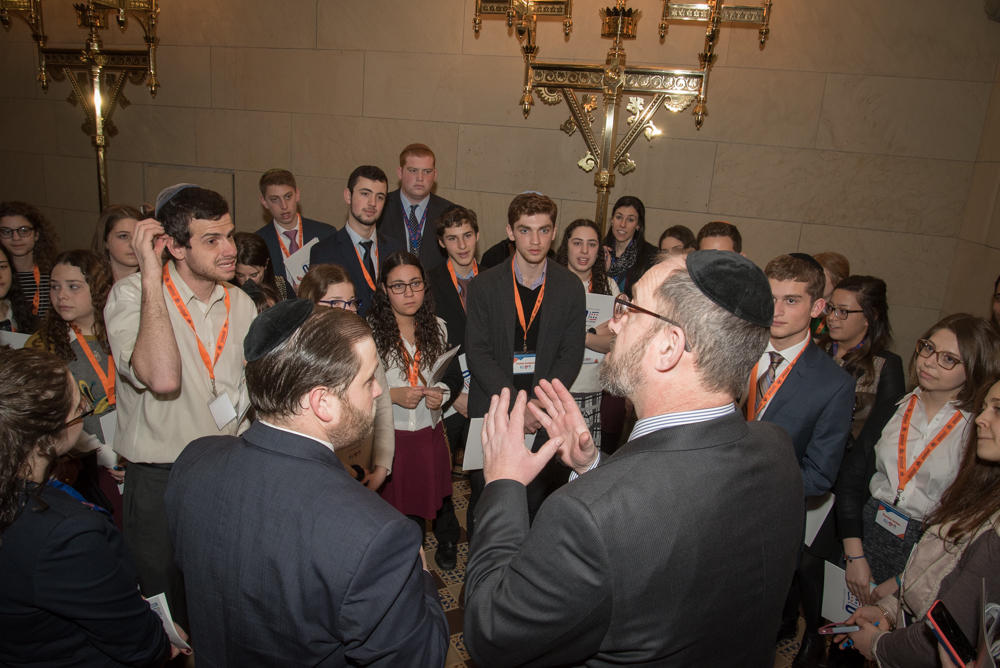
The Education Investment Incentives Act—also known as the Education Tax Credit—is good for both public and non-public schools: this was the message shared by many of the state legislators who met with today’s 50-person delegation, composed of individuals with special needs and mainstream high school students, who went to Albany to push for the passage of the Education Tax Credit bill.
Passing the Education Tax Credit is the top priority during the 2015 Legislative Session for OU Advocacy-Teach NYS, the nonpartisan public policy arm of the Orthodox Union, which organized the delegation together with Yachad, the flagship program of the Orthodox Union’s National Jewish Council for Disabilities.
Each legislator the delegation met emphasized the importance of the group’s advocacy, its presence in Albany, and the need to raise awareness about issues directly with state legislators. Assembly Member Michael Simanowitz added that members of the delegation must mobilize their communities at home to support the Education Tax Credit.
In addition to benefiting public and non-public schools, Assembly Member Simanowitz noted that the Education Tax Credit bill would benefit public school teachers because they would get tax credits for out-of-pocket expenses.
For families who already incur additional costs to support children with special needs, the Education Tax Credit is especially important. With scholarship aid from the Education Tax Credit, these families would be able to provide their children with the best education suited to their needs, without adding to their debt.
“Often, parents who have a child with special needs have to take second jobs to cover all of their bills. The Education Tax Credit would help them with their schooling bills, lightening their load,” said Deena Moskowitz, a Yachad Day Habilitation member.
“We are so pleased that our Day Habilitation participants and Youth Leadership Council students were able to take advantage of this important opportunity to help pass the Education Tax Credit for all of New York’s Jewish day school and non-public students,” said Dr. Jeffrey Lichtman, International Director of Yachad.
“Today’s mission was the perfect illustration that everyone can be an advocate and make a difference by coming to Albany and speaking with legislators,” said Arielle Frankston-Morris, Director of Field Operations for OU Advocacy-Teach NYS. “Yachad’s Day Habilitation participants and Youth Leadership Council students demonstrated to our state legislators that the Education Tax Credit bill has an important impact on the special needs community.”
“The Education Tax Credit bill has gained tremendous momentum over the past several years. With Governor Cuomo committing his support for the bill, the Senate passing the bill, and a significant amount of support for the bill in the Assembly, we are confident that 2015 will be the year of the Education Tax Credit, to benefit all of New York’s children,” said Jake Adler, New York Policy Director for OU Advocacy-Teach NYS.
Today’s mission was the second of four advocacy missions organized by OU Advocacy-Teach NYS in support of the Education Tax Credit. The first mission brought a joint delegation of 30 high school students to Albany from Yeshivah of Flatbush and Nazareth Regional High School. The remaining two missions will bring parents, students and Jewish day school leaders from across the state to Albany.
By encouraging individuals and corporations to make charitable contributions to public schools or scholarship-making organizations for tuition-paying families, the Education Tax Credit could generate an unprecedented amount of support to tuition-paying families and ensure that the program benefits the broadest swath of New York’s schoolchildren. Gov. Andrew Cuomo has included the credit in his Executive Budget. The bill in the state Senate is sponsored by Senators Martin J. Golden (R-Brooklyn) and Simcha Felder (D-Brooklyn); in the state Assembly, the bill is sponsored by Assembly Member Michael Cusick (D-Staten Island).
Judge Richard Bernstein, Blind from Birth, Leaves His Bench to Highlight New England Yachad Shabbaton in Boston, March 6-8
Judge Richard Bernstein
Justice Richard Bernstein has great affection for Yachad. Blind from birth, Justice Bernstein, who was elected to the Michigan Supreme Court in November 2014 – the first blind justice to sit on this court – has participated in a variety of events, including running in the Miami Marathon and Half Marathon (formerly the ING Miami Marathon and Half Marathon) as part of the Yachad delegation. So when Liz Offen, director of New England Yachad, based in Boston, needed a shabbaton guest speaker for the weekend of March 6-8, Parshat Ki Tisa, the Justice volunteered to take on the role.
“Yachad,” the flagship program of the Orthodox Union’sNational Jewish Council for Disabilities (NJCD), provides unique social, educational and recreational programs for individuals with learning, developmental and physical disabilities with the goal of their Inclusion in the total life of the Jewish community.
Justice Bernstein had been in Boston for five days for events at ReelAbilities Boston Film Festival, Harvard Law School and Gann Academy. “Despite having just been in the area for some days and then returned to Michigan, when the Justice learned about the upcoming event he immediately agreed to adjust his schedule and return to the area to speak on Yachad’s behalf,” Ms. Offen said. “He made plans to come back to Boston to headline the shabbaton at the Maimonides Kehillah, in a program supported by the Ruderman Family Foundation.”
The shabbaton features a weekend that brings together children with disabilities, high school peer participants and members of the local synagogue. “The Yachad Shabbaton is extra special because Justice Bernstein will be with us. We are so honored that he has agreed to address the community on the important issue of Inclusion,” said Sharon Shapiro of the Ruderman Family Foundation.
Ms. Offen explained, “Justice Bernstein has overcome blindness to rise to the heights of the legal profession as well as being an activist for those with disabilities, including Yachad. Besides running in the marathon, he has spoken at many Yachad events in schools and synagogues. His willingness to fly back and forth from Michigan to Boston twice in succession in the middle of a terrible winter demonstrates what a wonderful man he is. Justice Bernstein is a shining light to all who have the good fortune to be in his presence. It should be a wonderful shabbaton and a great event for Yachad.”
This article was written by the OU Staff.
The view the original article on the Orthodox Union website, click here.
Op-Ed: Speak out to make U.S. more inclusive for disabled
WASHINGTON (JTA) — A quarter-century ago, the Americans with Disabilities Act became the law of the land. That’s 25 years of progress, of advances that have improved the lives of people with disabilities beyond what was previously possible.
The Jewish community has joined in those efforts and sought to bring accessibility and awareness to the forefront. This February marks the seventh annual Jewish Disability Awareness Month, or JDAM.
Jewish institutions nationwide continue to redouble their efforts to foster inclusive communities for people with disabilities. Since the establishment of JDAM in 2009, advocates have been successful in many ways, starting with an increased effort by synagogues and other Jewish organizations to ensure that all Jews are able to fully participate in the Jewish life of their choosing, from accessing the bimah to holding leadership positions.
Yet too often, organizational initiatives to welcome people with disabilities fall under the purview of a single social action committee. We must help our institutions understand that accommodating people with disabilities is not a project. It is a basic prerequisite in ensuring our Jewish institutions serve our diverse Jewish population and foster a sacred community for all.
But even this is not enough. For all the progress we have made within our communities, these strides are not reflected in our nation’s laws. Together as a community, we must expand our focus outward, from inclusion efforts within Jewish institutions toward advocacy efforts on the national level for policies that advance disability rights.
As leaders of the Jewish Disability Network, a coalition of over two dozen Jewish organizations advocating for disability rights, advocates from across the country will join us this year on Capitol Hill on Feb. 25 for Jewish Disability Advocacy Day, where we will advocate for policies to make our country more inclusive for all people.
We will speak about the importance of Social Security Disability Insurance, which provides a safety net for people who become disabled and can no longer work and have contributed, through payroll taxes, to the Social Security Trust Fund. In 2013, more than 10.9 million people were SSDI beneficiaries, with average benefits amounting to around $1,140 per month.
SSDI is expected to become insolvent at the end of 2016, leading to across-the-board benefit cuts of 20 percent if no action is taken. Without these benefits, it is estimated that more than half of SSDI recipients would live in poverty.
Another important issue is the availability of accessible public transportation. Without transportation options, many are cut off from employment, health care and community involvement opportunities. Programs like Easter Seals’ Project Action and the Enhanced Mobility of Seniors and Individuals with Disabilities program helps meet some of the transit needs of people with disabilities, but programs like these are woefully underfunded.
As Congress debates reauthorization of the surface transportation bill, our senators and representatives should work to expand funding for these vital transportation programs serving people with disabilities.
As a Jewish community, it is our religious and social obligation to help realize a world where people with disabilities have equal opportunities. We hope you’ll join us this Jewish Disability Awareness Month in raising your voice in support of disability rights, both in your community and nationwide.
(William Daroff is the senior vice president for public policy and director of the Washington office of The Jewish Federations of North America. Rabbi Lynne Landsberg is the senior advisor on disability issues at the Religious Action Center of Reform Judaism.)